
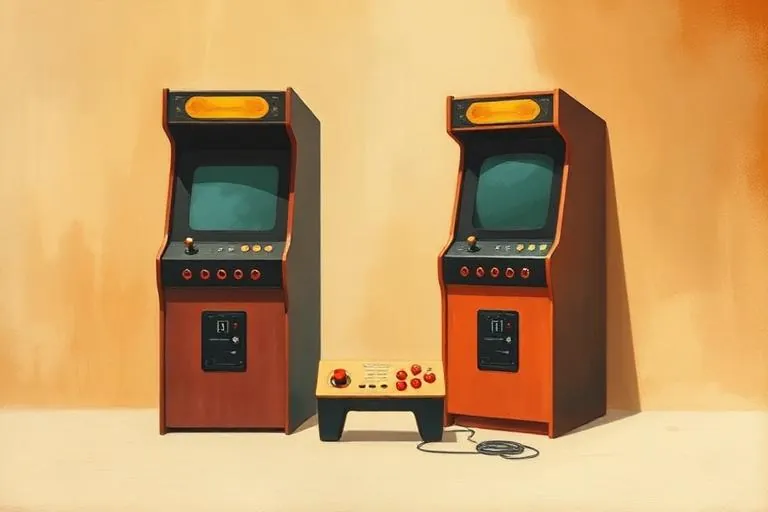
Games · 1950
Dawn of Computer Intelligence and Arcade Mechanicals
In 1950, the concept of video gaming emerged from academic research labs and public displays of early artificial intelligence. Meanwhile, electromechanical arcade technology flourished in amusement halls across the globe.
- 1950 | Custom Hardware | Canada
Bertie the Brain
Josef Kates unveils a massive four-meter-tall custom computer at the Canadian National Exhibition that allows players to challenge an AI to Tic-Tac-Toe.
- March 1950 | Academic Paper | USA
Programming a Computer for Playing Chess
Claude Shannon publishes the first detailed paper describing how a computer could be programmed to play a complete game of chess.
- October 1950 | Academic Paper | UK
Computing Machinery and Intelligence
Alan Turing publishes his landmark paper introducing the Imitation Game and laying the theoretical groundwork for game artificial intelligence.
- 1950 | Electromechanical | USA
Bank-A-Ball Pinball
Gottlieb releases Bank-A-Ball, a highly influential electromechanical pinball machine that helped standardize modern flipper configurations.
- May 1950 | Mainframe Hardware | UK
Pilot ACE Computer
The National Physical Laboratory constructs the Pilot ACE computer, which serves as the host system for early digital draughts experiments.
- 1950 | Arcade Machine | USA
Turf King Arcade Machine
Bally releases Turf King, a wildly popular horse-racing-themed electromechanical bingo arcade game that dominated amusement halls.
- June 1950 | Mainframe Hardware | USA
SEAC Computer Commissioning
The National Bureau of Standards brings SEAC online, enabling early digital demonstrations and logic-based computer experiments.
- 1950 | Software Design | UK
Strachey's Early Draughts Program
Christopher Strachey writes a preliminary program to play draughts for the newly commissioned Pilot ACE computing engine.
Enjoyed your trip back in time?