Tech & Science · 1904
Dawn of Electronics and Mass Transit
In 1904, industrial innovation and scientific breakthroughs transformed daily life and laid the foundation for modern electronics. From underground transit systems to fundamental physics theories, inventors pushed the boundaries of human capability.
- November 16, 1904 | United Kingdom
Fleming Thermionic Valve
John Ambrose Fleming patents the first vacuum tube diode, laying the fundamental cornerstone for the entire field of modern electronics.
- October 27, 1904 | United States
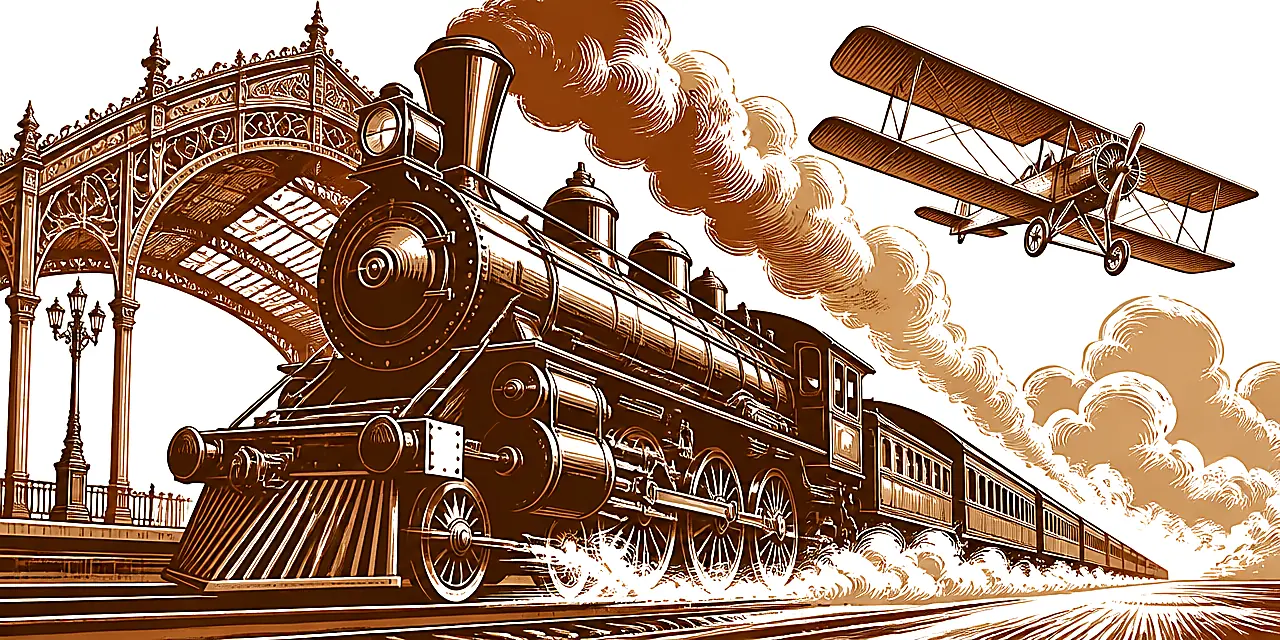
New York City Subway System
The Interborough Rapid Transit opens its first underground line, instantly revolutionizing urban transportation in New York City.
- November 24, 1904 | United States
Holt Crawler Tractor
Benjamin Holt successfully tests the first practical continuous track tractor, laying the groundwork for heavy machinery and future armored vehicles.
- August 1904 | Germany
Prandtl's Boundary Layer Concept
Ludwig Prandtl introduces the revolutionary concept of the boundary layer, transforming fluid dynamics and enabling modern aerodynamics.
- 1904 | United States
Offset Printing Press
Ira Washington Rubel invents the offset lithographic printing press, enabling rapid, high-quality printing that revolutionizes the publishing industry.
- 1904 | Denmark
Poulsen Arc Radio Transmitter
Valdemar Poulsen patents an arc transmitter capable of generating continuous radio waves, paving the way for audio radio broadcasting.
- 1904 | Germany
Korn Wire Phototelegraphy
Arthur Korn successfully transmits high-resolution photographs across long-distance telecommunication wires using selenium cells.
- 1904 | Germany
Commercial Launch of Veronal
Merck begins marketing Veronal, the first commercially available barbiturate, pioneering modern psychiatric pharmacology and sedatives.
Enjoyed your trip back in time?