
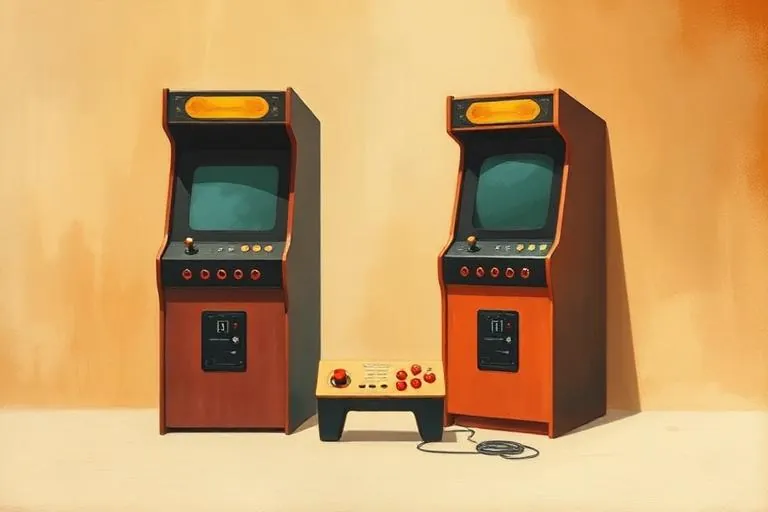
Games · 1948
The Dawn of Interactive Screens and Algorithms
In 1948, interactive electronic entertainment existed primarily in patent filings and theoretical algorithms. Meanwhile, electro-mechanical pinball machines dominated physical arcades while early room-sized mainframes began to execute their very first programs.
- Dec 14, 1948 | Hardware Patent | USA
Cathode-Ray Tube Amusement Device Patent
Thomas T. Goldsmith Jr. and Estle Ray Mann are granted a patent for an interactive CRT missile-firing game, the earliest electronic video game hardware design.
- 1948 | Algorithm | United Kingdom
Turochamp
Alan Turing and David Champernowne author Turochamp, an early computer chess algorithm written on paper before hardware existed capable of running it.
- June 21, 1948 | Hardware | United Kingdom
Manchester Small-Scale Experimental Machine
Nicknamed the Baby, the SSEM runs its first program, becoming the world's first electronic stored-program computer and foundational gaming precursor.
- March 1948 | Arcade Pinball | USA
Gottlieb Cinderella
D. Gottlieb & Company releases Cinderella, an arcade pinball hit that helped popularize player-controlled flippers across amusement parlors nationwide.
- Jan 1948 | Arcade Pinball | USA
Gottlieb Robin Hood
Gottlieb publishes Robin Hood, an early pinball machine utilizing newly invented active playfield flippers to transform coin-operated entertainment.
- 1948 | Arcade Pinball | USA
Bally Carnival
Bally Manufacturing releases Carnival, competing in the booming post-war arcade market with interactive electro-mechanical pinball playfield features.
- 1948 | Arcade Pinball | USA
Williams Rainbow
Designer Harry Williams crafts Rainbow, a notable early electro-mechanical pinball machine featuring innovative bumper layouts and scoring devices.
- 1948 | Theoretical Science | USA
Cybernetics Publication
Norbert Wiener publishes Cybernetics, establishing feedback loop principles that directly inspired early computer game development and artificial intelligence.
Enjoyed your trip back in time?